
From confusion, to clarity, to completion
Writing a thesis takes more than academic ability. It takes structure, strategy, and the resilience to keep going over a long project. The Dale Method is the framework that holds all three together.
A thesis is a banquet you cannot finish at one sitting
When you begin a postgraduate degree, you commit to submitting a thesis at the required standard before you graduate. Miss that, and the result is often years of delay, stress, and quiet misery.
Submitting a good thesis is difficult, but it is not impossible. When Caroline Dale wrote her own, she could not find a practical methodology to guide her. So she built one.
No matter how capable you are, there is no shortcut to a strong result without breaking the work into logical, manageable sections. That single insight is what the Dale Method is built around.
━ Where it starts
The most important thing you can do right now is to reorient your mindset and get your systems in place. That is the foundation everything else is planned from.
Students with the right systems and daily habits routinely succeed beyond their own expectations. Those who resist planning and working in discrete, incremental sections tend to struggle from day one.
━ The methodology
One framework. Three parts. Seven phases.
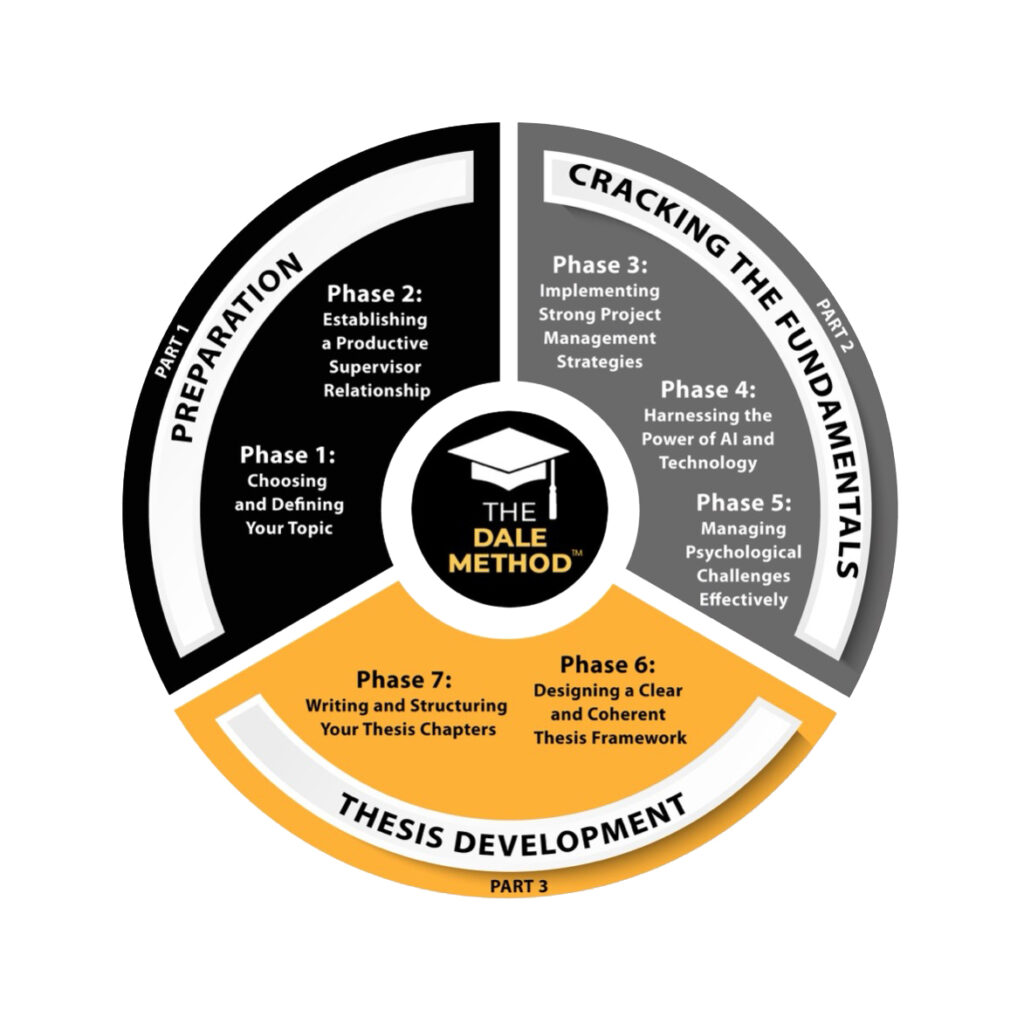
The Dale Method addresses every element of postgraduate study, so you stay in control throughout the year. It moves you through three connected parts, built from seven practical phases.
━ Cyclical, not linear
You move between phases as your challenge demands
These phases are not a straight line. The method is cyclical and flexible: you move in and out of each phase depending on the challenge directly in front of you. That is what keeps the whole project feeling manageable instead of overwhelming.
━ The framework in full
Every phase, broken down
A complete view of the three parts and the topics inside each phase, exactly as you will work through them.
![roadmad-framework-[Recovered]](https://dev.thethesiscoach.com/wp-content/uploads/2026/07/roadmad-framework-Recovered.jpg "roadmad-framework-[Recovered]")
The Dale Method framework, from preparation through to a fully structured thesis.
━ Why it works
Built for the whole journey
━ Your next step
Submit your thesis. Get your life back.
Submitting a good thesis is difficult, but not impossible. The Dale Method gives you the structure to do it.